
Advancing Education for Refugees: 2026 Refugee & Migrant Education Network (RMEN) Conference
19 October 2026|Dr John Bosco Ngendakurio
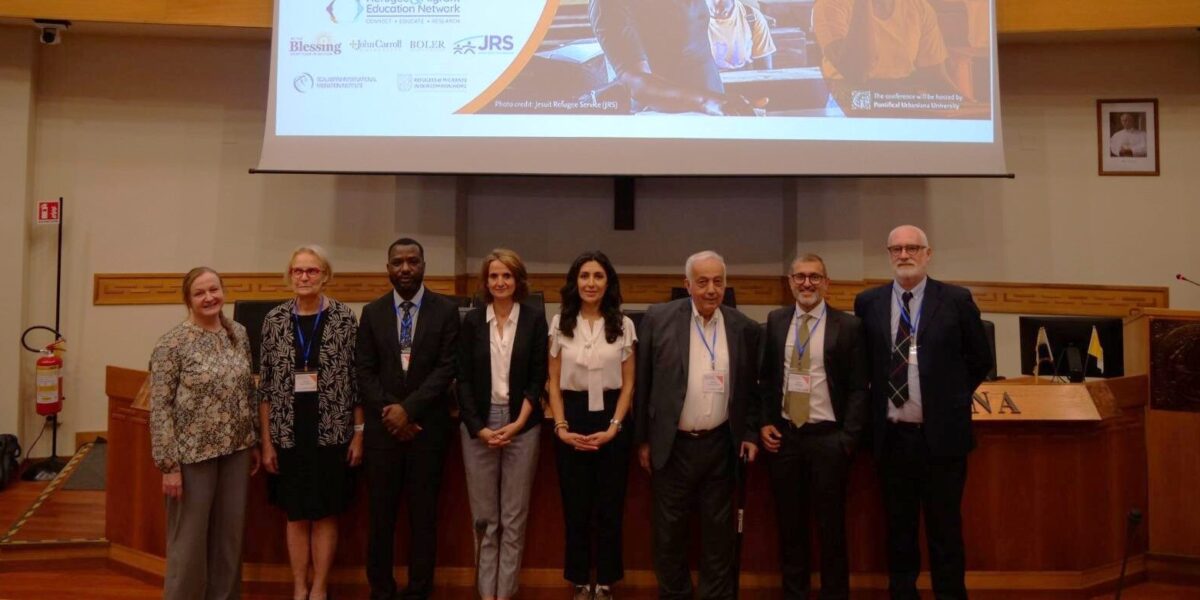
Dr John Bosco Ngendakurio, JRS Australia’s Head of Operations, recently joined global partners at the 2026 Refugee & Migrant Education Network (RMEN) Conference held in Rome.
From 30 September to 2 October 2026, members of the international community gathered to coordinate solutions to enable refugees globally to access higher standards of education.
Dr Ngendakurio joined as JRS Australia’s representative, and to offer his own insights as a former refugee.
A highlight of the RMEN Conference was the second-day plenary session organised, coordinated, and moderated by Mr Marco Grazia, Head of Education at Jesuit Refugee Service.
This plenary brought together senior representatives from the education departments of UNHCR, UNICEF, UNESCO, the global coordinator of the African Higher Education in Emergencies Network (AHEEN), alongside Dr Ngendakurio.
Plenary discussions explored how funding cuts and persistent barriers threaten access to, and continuity of, quality education.
Members examined sustainable solutions, particularly for tertiary education, sharing successful pilot models and exploring how promising practices could be scaled up.
Importantly, conference members agreed that stronger and strategic collaborations between universities, UN agencies, non-governmental organisations, providers on the ground, and governments will be essential to maximize refugee and migrants’ educational opportunities and outcomes.
Dr Ngendakurio, raised JRS Australia’s advocacy for refugees and migrants to be included in host countries’ national education systems and expand their access to secondary and tertiary education.
Through Dr Ngendakurio, JRS was also proud to emphasise that education responses must recognise the experiences of torture and trauma among refugees, people seeking asylum, and others who have faced displaced people.
We encouraged policymakers and service providers to ensure these experiences inform education planning, strategy and implementation, helping create safe, inclusive and supportive learning environments that provide refugee children real opportunities to thrive.
JRS also helped facilitate a UNHCR pre-conference event, which presented Aiming Higher, a new tertiary education initiative designed to expand refugees’ access to tertiary education through stronger partnerships and sustainable pathways.
The conference participants were encouraged by the dialogue, shared commitment, and willingness to collaborate.
Universities, NGOs, and refugee representatives contributed recommendations to shape and finalise the initiative, with an official launch envisaged for early 2027.
“The true measure of success will be what happens next,” shared Dr Ngendakurio.
“That is, we need to ensure these discussions lead to meaningful partnerships, sustainable funding, and expanded opportunities for learners too often excluded from education.”
We are grateful to Dr John Bosco Ngendakurio for his advocacy at the 2026 Refugee and Migrant Education Network Conference, and for the expertise he brings to our work.
You can read more about John below, in his feature interview with our global office.
Interview: What does it mean to accompany refugee communities in Australia?

Explore more
