Khujesta’s Story: from Learning to Leading through Digital Skills
29 August 2025|Khujesta Qayam; Carla Hazrouni
When Khujesta arrived in Australia in March 2024 with her husband and two young sons, she brought with her an extraordinary professional background and the determination to begin again. Like many refugees and people seeking asylum, however, both Khujesta and her husband faced significant barriers to recognition of her past qualifications.
Khujesta is a talented professional and mentor.
At home in Afghanistan, Khujesta earned degrees in Islamic Shariya and Geology and Mining, wrote seven books on topics around Engineering and Mathematics, she taught at college, and held senior roles including as the Director of the National Environment Protection Agency (NEPA) in Afghanisation.
Khujesta was about to be appointed to a position as Deputy Governor when the government collapsed- and even afterwards she continued to work with the United Nations Development Program (UNPD) in the North of Afghanistan.
Following the fall of Kabul, Khujesta’s life changed overnight. With the help of her husband’s relative, an Afghan Australian advocate, she and her family were sponsored to evacuate to Australia through a humanitarian program.
The Challenge of Starting Again
Like many refugees and people seeking asylum in Australia, Khujesta faced the difficult reality that her extensive qualifications and experience were not recognised here. Refugees often arrive with skills, professional expertise, and years of experience, yet face systemic barriers to securing meaningful and sufficient employment.
Her husband, a former GP and security intelligence professional, faced the same barriers.
From limited recognition of overseas qualifications to unfamiliar recruitment processes, and the need to learn new workplace cultures – these barriers can often be insurmountable without advocacy and support.
Despite a successful career, Khujesta felt she had to start from scratch in Australia.
“I was worried that I cannot find a job based on my field of study or experience.” Khujesta says. ‘Even though I had previous UN experience – but it’s hard to join the UN in different countries.”
That’s where JRS’s Employment Program came in.
Employment Assistance and Training at JRS
Within her first week in Sydney, Khujesta attended a community orientation session. Through Centrelink, she was introduced to the Finding Safety Project and met the Project’s Manager Sara Muzamil.
Sara encouraged Khujesta to volunteer as a Community Mobiliser, and soon after, Khujesta connected with Tamana from JRS’s Employment Program. Tamana offered training opportunities that helped rebuild Khujesta’s confidence and introduced her to potential employers.
JRS Australia’s Employment Program is designed to address exactly these challenges by providing refugees with skills training, mentoring, and connections that help them overcome barriers and re-establish themselves professionally in Australia.
From Learner to Mentor
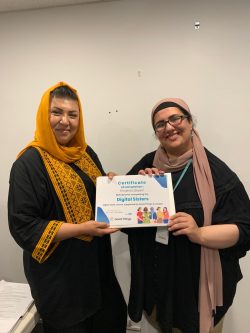
During her participation in JRS Australia’s Employment Program, Khujesta participated in our Digital Sisters Project – which supported women to further develop their digital literacy skills, and connected all participants with a digital device.
This connection opened doors for Khujesta. First to a short-term role with Polaron, and then to a position as Lead Digital Mentor with Collective Leisure. In this role, Khujesta works across three projects: Digital Literacy for Seniors, Youth Mentoring, and the Digital Sisters Program; an initiative that empowers women to build their technology skills and independence.
“The Digital Sisters program was especially helpful,” says Khujesta. “It gave me a certificate, new skills, and the confidence to teach others.”
Today Khujesta isn’t just learning, she’s mentoring. She is helping other women navigate technology, gain confidence, and open doors for themselves.
Alongside her work, she has completed Certificates III in Children’s Services, Administration Skills, and English, and is fast-tracking a Diploma of Counselling.
When refugees find work, they are making real and tangible contributions to our community.
Khujesta’s story is a source of inspiration for us. We know that when refugees find work, the benefits extend far beyond the individual.
Like so many refugees and people seeking asylum, Khujesta has not only bounced back from hardship, but continues to make tangible contributions to our community by sharing skills, building social connections and giving back.
In Khujesta’s case, her contributions extent beyond her digital literacy work. Through her volunteer role as a Community Mobiliser with the Finding Safety Project, she helps other women connect with resources, navigate services, and build safe, supportive networks.
“I am so grateful to JRS,” Khujesta says. “It feels like a family, a place where I can be myself, cry, and be happy. And I’m grateful to Australia for giving us freedom, safety, and opportunity. Sara and Tamana played a key role in my life and career here”.
Khujesta’s husband is now also studying in his field while caring for their youngest child – and their eldest is thriving at school. Khujesta works hard to support their family financially.
Khujesta’s journey reflects what National Skills Week is all about: recognising skills, building new ones, and making real contributions to the community.
Refugees like Khujesta bring knowledge, resilience, and leadership, and with the right support, they don’t just start over, they help others rise too.
Support Refugees to Find Meaningful Work
So many of the people we serve, like Khujesta, are required to start from scratch when they seek asylum in Australia as their credentials are not recognised.
With your help, we can continue to provide opportunities and employment pathways for all refugees and people seeking asylum in Australia.
Learn more about our Employment Program here.
And please consider making a donation directly to the program, to support others like Khujesta to find meaningful work.