Finding Safety: A Blueprint for reform to protect women on temporary visas experiencing violence
24 September 2026|Molly Jackson
Women should never have to choose between staying in violence and losing their safety, housing, income or future because of their visa status.
Through our Finding Safety Project, Jesuit Refugee Service (JRS) Australia works alongside women on temporary visas and women seeking asylum who are experiencing, or at risk of experiencing, sexual and gender-based violence.
Temporary visa status can shape a woman’s ability to leave violence and find safety. A lack of access to income, housing, healthcare, legal support and secure migration pathways can make it incredibly difficult for women to rebuild their lives after violence.
These experiences are the result of gaps in our systems – meant to protect people, but instead exluding the most vulnerable people in our community.
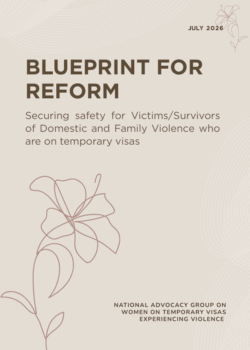
We are proud to have launched, through the National Advocacy Group on Women on Temporary Visas Experiencing Violence (NAG), the new Blueprint for Reform: Securing Safety for Victims/Survivors of Domestic and Family Violence on Temporary Visas.
From Finding Safety to systemic change
The Finding Safety Project has been working with women experiencing violence since 2018. Based at JRS Australia’s Women’s Space in Western Sydney, the project provides specialist casework, psychosocial support, emergency assistance, community activities and opportunities for women to build skills, leadership and connection.
This frontline work has shown us how closely violence, migration status and financial and housing insecurity can be connected.
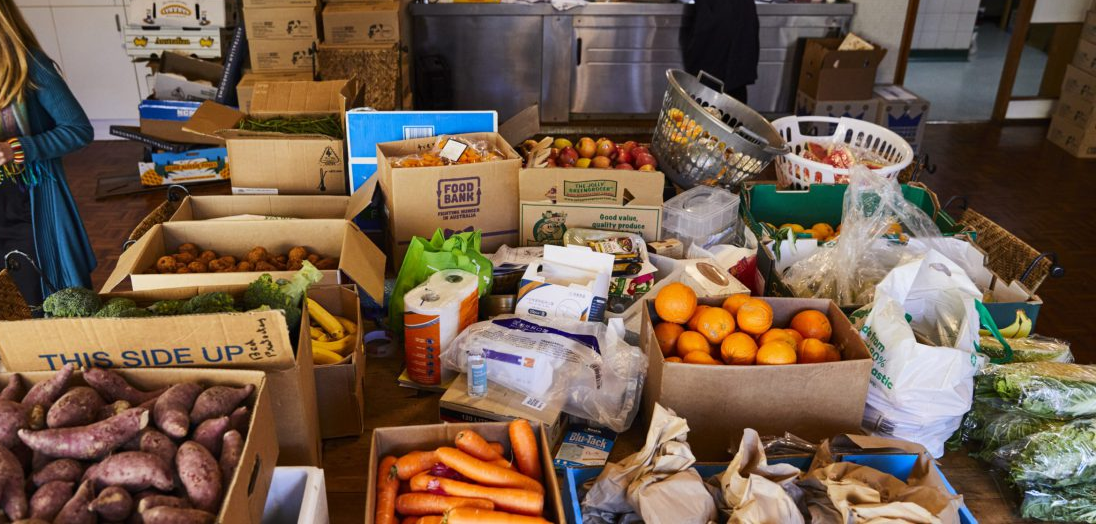
For some women, leaving a violent relationship can mean losing access to income or housing. Others may be unable to access services because of their visa conditions, or may not be eligible for existing family violence provisions. Women can also face the threat of homelessness when refuges and other housing services are unable to accommodate people without income or a secure pathway forward.
The result is a system where the decision to leave violence does not always lead to safety. The Blueprint sets out to change this.
The NAG brings together more than 30 organisations, peak bodies, service providers and individuals working across Australia to advocate for change for women on temporary visas experiencing violence. JRS Australia is an executive member of the group, bringing the expertise and insights of the Finding Safety Project to this national advocacy.
A Blueprint shaped by frontline experience
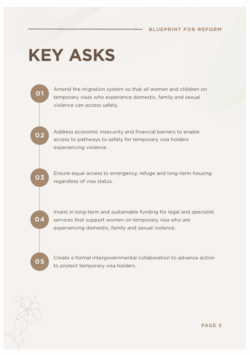
The Blueprint for Reform identifies five areas where change is needed to ensure women on temporary visas can access safety and justice:
- Reform the migration system so visa status does not prevent women experiencing violence from accessing protection and justice.
- Address economic insecurity, including barriers to income support, employment and essential services.
- Ensure equal access to housing, including social and public housing for people experiencing violence.
- Secure long-term funding for legal and specialist services supporting women experiencing or at risk of domestic and family violence.
- Establish formal intergovernmental collaboration so governments and services can respond more effectively to the needs of women on temporary visas.
Among its recommendations, the Blueprint calls for a dedicated visa pathway for victim-survivors who cannot rely on existing family violence provisions, as well as expanded access to social security and Medicare and stronger safeguards against systems being used by perpetrators to control or threaten women.
These recommendations reflect what the Finding Safety team sees in practice: safety cannot be separated from housing, income, healthcare, legal support and secure migration pathways.
Listening to women and changing systems
 Working alongside women experiencing violence, we know the key to making systems work better is ensuring women have agency in decisions about their own lives and the support they receive.
Our advocacy is informed by the women we accompany, as well as by the specialist knowledge of our practitioners and our partnerships across the family violence, refugee and migrant sectors.
This connection between accompaniment, service and advocacy is central to our mission.
Our role is to work alongside women and communities, support their agency and use what we learn through this work to advocate for systems that enable people to live with safety and dignity. The Blueprint is an important part of that work.
Learn more about JRS Australia’s Finding Safety Project.

Explore more